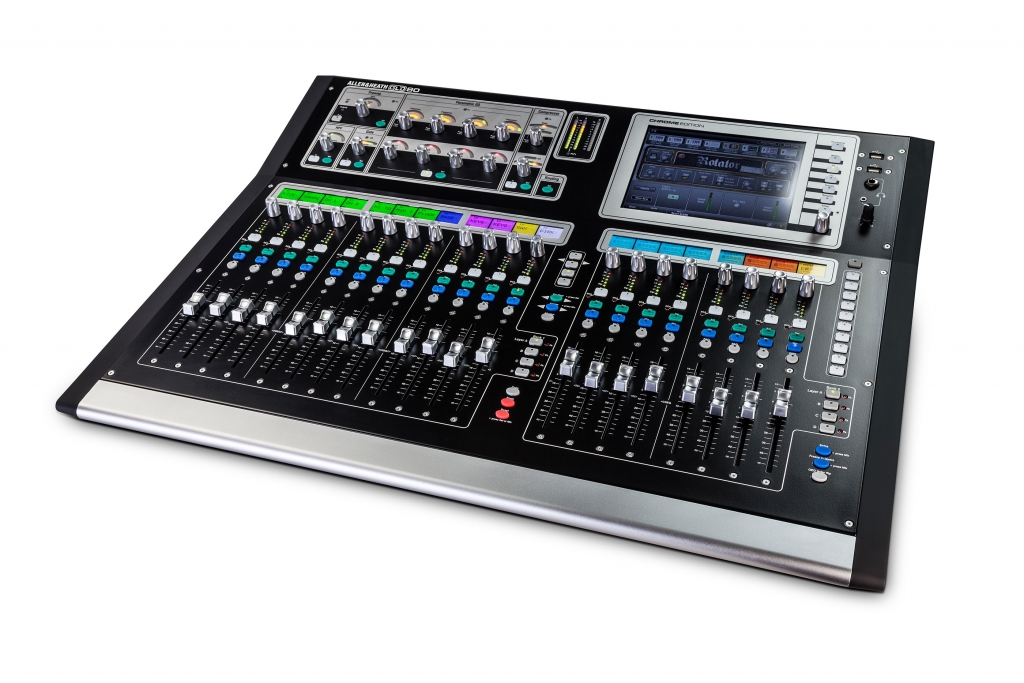
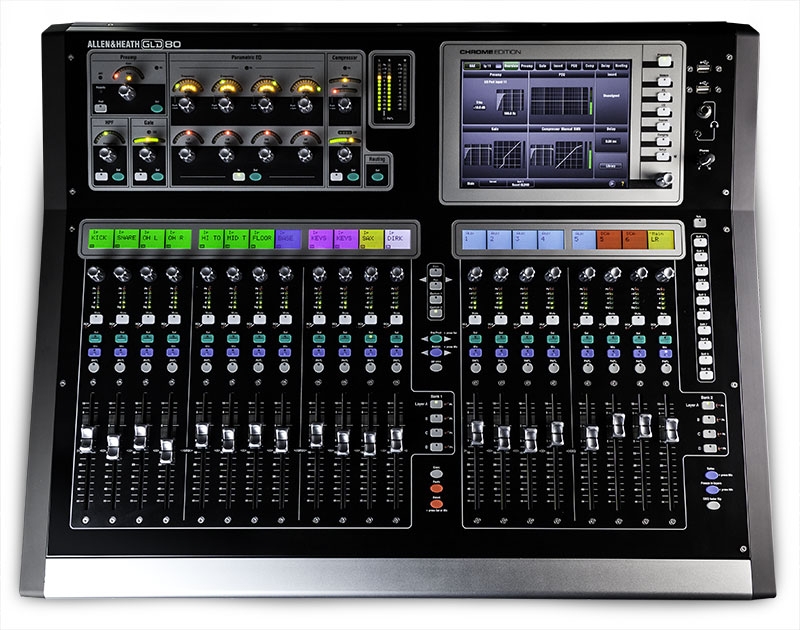
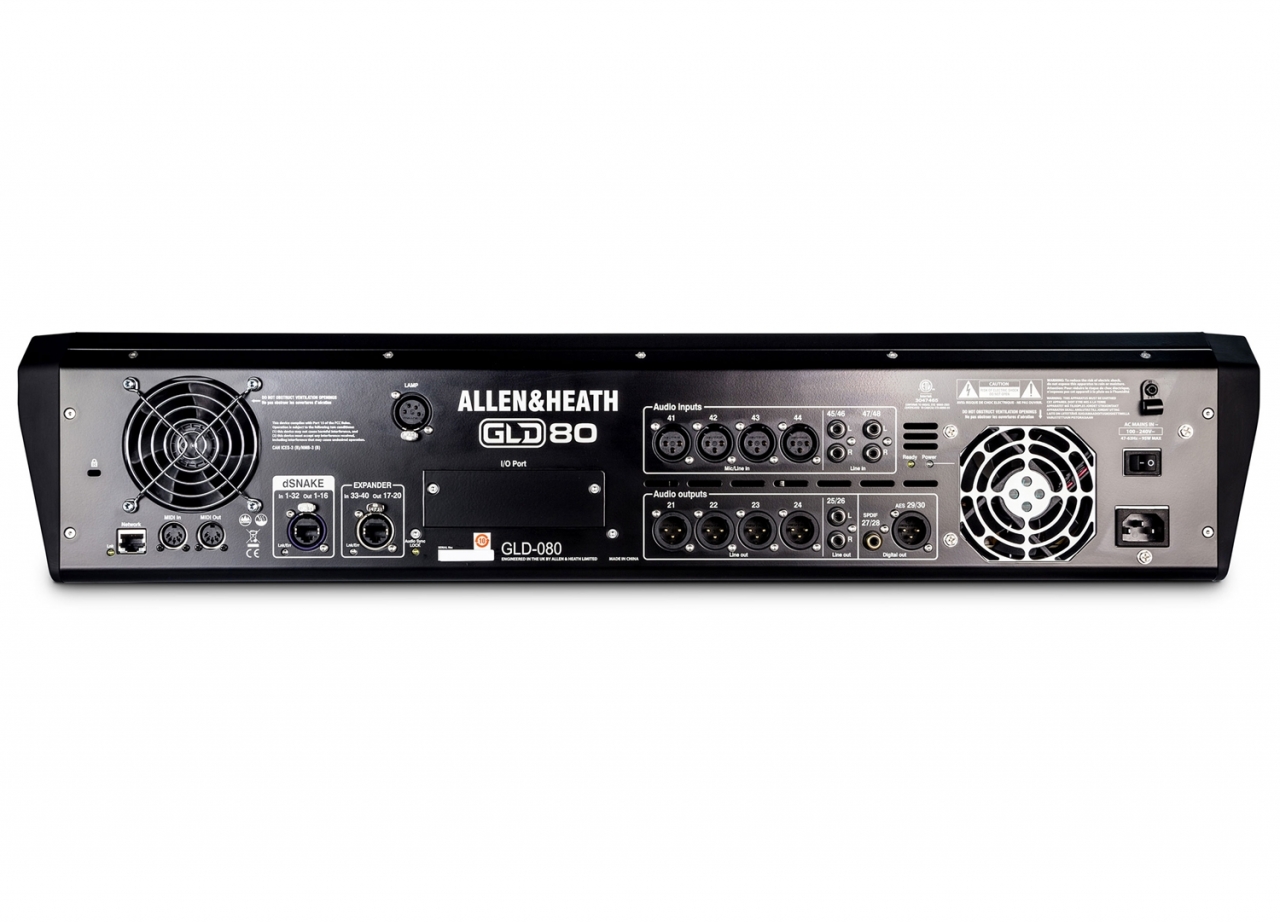
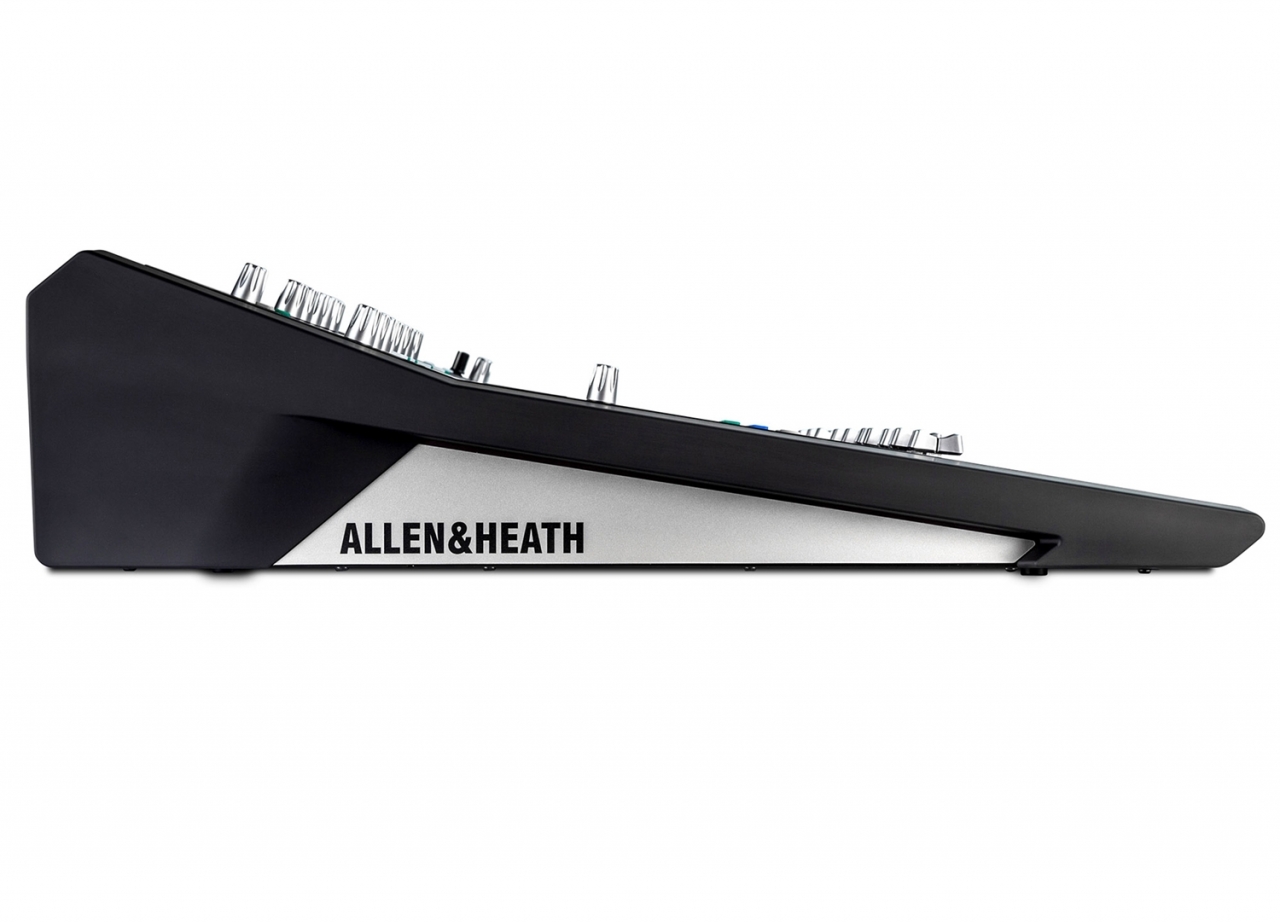
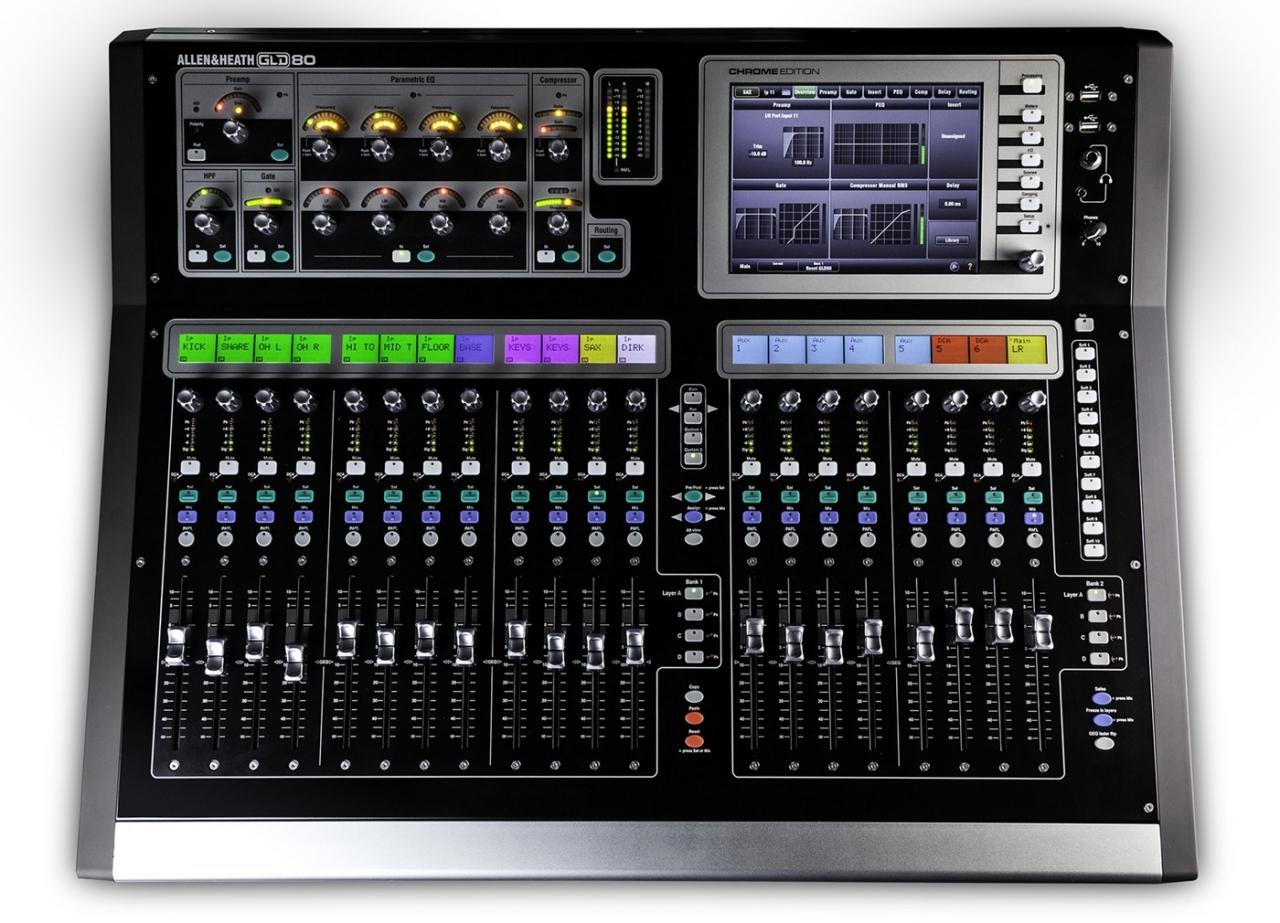
Allen&Heath GLD-80 • compact digital mixing system with expandable and remotely controlled inputs/outputs • system from 4 to 44 microphone inputs • dSNAKE • 8.4" color touchscreen display • 20 motorized faders, 4 layers, control of up to 80 adjustable channels • up to 48 inputs, 30 buses, 20 outputs • 16x DCA/Mute groups • built-in Talkback, RTA, and signal generator • MIDI input/output and Ethernet port • Aviom port • high-end microphone/line preamps • channel display for naming and color-coding • software patchbay (inputs/outputs and inserts) • dimensions: 730 x 577 x 159(mm) • weight: 16 kg
Mixing consoles
GLD Chrome edition now feature a metallic finish, along with new functions.
Auto Mic Mixing and other added tools, combined with a user-friendly signal processing interface, are complemented by faithfully designed compressor emulation effects on each input channel.
The
AMM function, or
"Automatic Mic Mixer", allows automated control of 44 microphone inputs, freeing users from the need to manually adjust output levels of individual microphones during long speeches. The
Chair button enables easy priority assignment, for example, using the CEO's speech as a source for ducking all other microphone inputs. These enhancements can now be activated in two modes:
"D-Classic", which offers dynamic gain sharing for instant and easy workspace setup, and
"Number of Open Microphones" (NOM), an intelligent technology for gate control, allowing flexible automatic mixing with advanced settings.
The
DEEP plugin architecture, newly included in the
GLD Chrome firmware, allows users to place any effect unit from the list on an optional input and mixing channel. Two new compressors,
16T and
16VU, inspired by
RMS-VCA technology, are now selectable among six other compressor types in the channel strip, saving valuable space in effect slots and reducing latency.
Firmware 1.5 Chrome brings updates to the well-known set of
on-board effects from Allen & Heath.
The new
Stereo Tap Delay allows a maximum delay of 2.7 seconds, LR time division, switching between delay display in milliseconds or BPM with indicated times and clear Tap Tempo functions. The new
Bucket Brigade delay is a full emulation of nonlinear delay units based on relay switching principles.
Echo, a highly faithful emulation of tape delay, popular in the seventies, delivers an authentic and well-known sound modeling the organic imprecision of tape systems.
GLD-80 is a user-friendly, affordable, and expandable digital mixing system conceptually based on the successful iLive series. The standard GLD system (GLD-80 + AR2412) includes 32 inputs, 28 of which are microphone (XLR) inputs with the possibility of expanding up to 48 inputs (44x XLR microphone inputs). The core of the GLD-80 system allows processing of 48 channels, 8 stereo effect returns, 30 configurable buses, 20 processing channels, and DSP power enabling full utilization of the system without compromises. GLD-80 features an analog-style control section complemented by a touch-sensitive, color 8.4" display. Fully customizable layout allows for easy and quick assignment of inputs and mixes to channels (via drag and drop). GLD-80 includes 20 channel faders in 4 layers with motorized faders, channel LCD display that can be named and color-coded, plus a rotary encoder for direct access to gain, pan, and AUX/FX sends control. GLD-80 includes 4 local inputs (XLR, microphone/line), 4 XLR line outputs, 4 RCA inputs, 2 RCA outputs, and digital SPDIF and AES3 outputs. GLD-80 can be expanded with a range of plug 'n play input/output racks, allowing for systems with 28, 36, or 44 microphone inputs. Using a CAT-5 cable up to 120m in length and the dSNAKE protocol, the basic AR2412 rack (24x XLR input, 12 XLR output) and up to two AR84 expansion racks (8x XLR input, 4x output each) can be connected, enabling remote control of preamp gains. Preamp settings can be saved in scenes and recalled as needed. Additionally, AR2412 allows integration with personal monitoring systems via the AVIOM interface. GLD supports recording/playback of stereo signals from a USB flash drive. For multi-track recording, FOH/monitor split, integration with iLive systems, the system can be expanded using additional cards such as DANTE, MADI, EtherSound, ACE, Waves, MMO, easily set up via the GLD software patchbay system.
• Compact digital mixing system with expandable and remotely controlled inputs/outputs
• System from 4 to 44 microphone inputs
• Easy and quickly accessible analog-style interface
• dSNAKE - digital multichannel signal transmission including control (up to 120m, CAT-5 cable)
• 8x RackFX from the iLive series
• 8.4" color touchscreen display for graphical display and settings
• 20 motorized faders, 4 layers, control of up to 80 adjustable channels
• Up to 48 inputs -> 30 assignable buses (AUX, GROUP, Matrix, Main, FX Send) -> 20 mix outputs
• 8x stereo RackFX effects unit with "short" return assignment with 4-band PEQ
• Processing on all inputs includes: gain, polarity, HPF, insert, gate, 4-band PEQ, compressor, and delay
• Processing on all outputs includes: insert, PEQ, GEQ, compressor, and delay
• Main mix modes: LR, None (monitors), LR + M (sum), LR + M (bus), LCR
• 16 DCA/Mute groups
• Built-in Talkback, RTA, and signal generator
• Expandable with input/output modules for FOH/Monitor split, multi-track recording, connection to iLive, and more
• MIDI input/output and Ethernet port
• Aviom port on the main AudioRack for personal monitoring systems
• High-end microphone/line preamps
• User-adjustable channel names and color-coding
• Software patchbay (inputs/outputs and inserts)
• Quick reset, parameter copy/paste
• Memory for libraries, scenes, and shows with USB transfer
• Internal memory includes default show presets for quick start
• Dimensions: 730 x 577 x 159(mm)
• Weight: 16 kg